
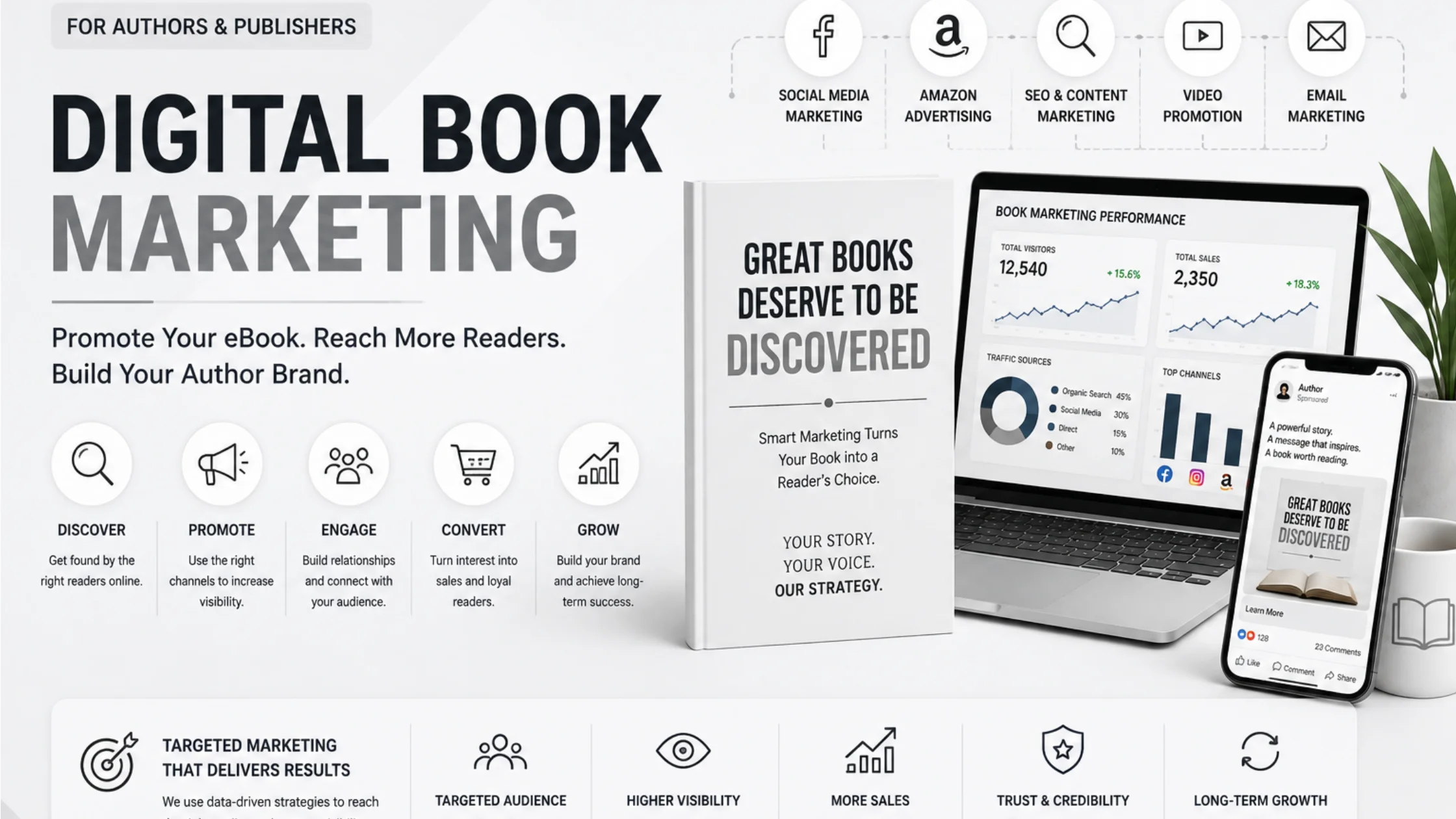
Publishing a digital book is easier than ever, but getting readers to discover and buy that book is a different challenge.
An author can write an excellent eBook, publish it on Amazon Kindle, add a professional cover, and make it available worldwide. But without an effective digital book marketing strategy, the book can easily become one title among thousands competing for the same readers.
This is why digital book marketing has become an essential part of modern publishing.
Digital book marketing is the process of promoting an eBook through online channels such as search engines, Amazon, social media, websites, email marketing, digital advertising, author platforms, and other relevant channels.
A successful strategy is not simply about posting a picture of your book on social media and asking people to buy it. It is about creating a complete reader-discovery journey:
Discover → Learn → Trust → Consider → Purchase → Recommend
For authors, this journey is becoming even more important as readers use Google, Amazon, social media, and AI-powered search tools to discover books and information.
Amazon provides several promotional options for authors, including Author Central, Amazon Advertising, Kindle-related promotions, pre-orders, giveaways, and other marketing tools.
At the same time, modern search increasingly rewards useful, people-first content and clear information.
That means modern book marketing needs to combine traditional digital marketing with SEO, GEO, AEO, content strategy, and strong author branding.

What Is Digital Book Marketing?
Digital book marketing is the online promotion of an eBook or author’s book to attract relevant readers, increase awareness, generate traffic, and encourage sales or downloads.
It can include:
- Search engine optimization
- Amazon book optimization
- Social media marketing
- Content marketing
- Email marketing
- Author website marketing
- Online advertising
- Book launch campaigns
- Reader engagement
- Influencer and creator outreach
- Digital PR
- Reviews and social proof
- Video marketing
- Blog marketing
- AI-search optimization
The exact strategy depends on the book.
A romance novel, business book, children’s book, memoir, cookbook, and academic guide should not necessarily use the same marketing approach.
The first question should always be:
Who is most likely to read this book, and where do those readers spend their time online?
Once that question is answered, marketing becomes much more focused.
Why Is Digital Book Marketing Important?
Simply publishing a book does not guarantee that readers will find it.
Imagine an author publishes a fantastic eBook but does nothing afterward.
There may be:
- No author website
- No search optimization
- No social media campaign
- No email list
- No promotional content
- No advertising
- No reader outreach
- No launch strategy
The book exists, but very few people may know it exists.
Digital marketing helps solve the visibility problem.
The objective is to put your book in front of people who are already interested in its subject, genre, solution, or story.
For example, an author who writes a book about beginner photography could target readers searching for:
- photography books for beginners
- learn photography
- beginner camera guide
- photography techniques
- how to take better photos
A romance author might focus on:
- contemporary romance books
- enemies-to-lovers romance
- romantic fiction
- small-town romance
- emotional romance novels
The marketing strategy changes according to reader intent.
Digital Book Marketing vs. Traditional Book Marketing
Traditional book marketing might include:
- Bookstore events
- Printed flyers
- Posters
- Newspaper advertising
- Physical events
- Book signings
- Direct mail
These methods can still be useful.
But digital marketing provides something traditional marketing often cannot provide at the same scale: measurable online reach.
An author can see:
- How many people visited a page
- How many clicked an advertisement
- Which social post received engagement
- Which keywords generated traffic
- Which pages readers viewed
- Which campaigns produced conversions
- Which audiences responded best
This information can help authors improve their marketing over time.
The Foundation of a Successful Digital Book Marketing Strategy
Before spending money on advertising or publishing dozens of social media posts, establish the foundation.
1. Know Your Target Reader
The most important question is:
Who is your book for?
Don’t answer:
“Everyone.”
A book written for everyone is often difficult to market effectively.
Instead, define your ideal reader.
Consider:
- Age range
- Interests
- Profession
- Reading habits
- Problems
- Goals
- Preferred genres
- Search behavior
- Buying motivations
For example:
“My book is a practical personal-finance guide for young professionals who want to manage their money and start investing.”
That is much easier to market than:
“My book is for anyone interested in money.”
The more clearly you understand your reader, the more effectively you can communicate with them.
2. Position Your Book Clearly
Book positioning answers:
Why should someone choose this book?
Your positioning can be based on:
- Topic
- Genre
- Unique perspective
- Author expertise
- Target audience
- Problem solved
- Experience provided
- Practical outcome
For example:
Instead of:
A Book About Leadership
you might position it as:
A practical leadership guide for first-time managers learning how to build high-performing teams.
The second statement communicates much more information.
It can also provide useful language for:
- Website copy
- Amazon description
- Social media
- Advertising
- Blog content
- SEO
- AEO
- GEO
3. Optimize Your Book Metadata
Metadata is one of the most important foundations of digital book discoverability.
For Amazon KDP, important metadata includes:
- Title
- Subtitle
- Description
- Author
- Contributors
- Publisher
- Keywords
- Categories
- Primary audience
- Marketplace
- Cover information
Metadata should not be treated as an administrative formality. It is part of marketing.
4. Use eBook SEO to Improve Discoverability
Digital book marketing and SEO work closely together.
eBook SEO helps optimize the information surrounding your book so that search engines and digital platforms can better understand its topic and connect it with relevant searches.
Important SEO elements can include:
- Book-related keywords
- Author name
- Book title
- Subtitle
- Book description
- Website content
- Blog articles
- Internal links
- Image optimization
- Structured data
- Relevant backlinks
- Search-focused content
For example, if your eBook is about starting a small business, your website could publish useful content around topics such as:
- How to start a small business
- Small business planning for beginners
- How to create a business plan
- Common mistakes new entrepreneurs make
- How to market a small business
These articles can introduce new audiences to your website and eventually to your book.
5. Build an Author Website
An author website gives you a central online destination that you control.
Your website can contain:
- Home Page — A clear introduction to your author brand.
- About Page — Your background, experience, interests, and author story.
- Book Page — Information about each book.
- Blog — Useful content related to your books and expertise.
- Media Page — Interviews, podcasts, press mentions, and other appearances.
- Contact Page — A way for readers, media professionals, and potential partners to contact you.
- Purchase Links — Clear paths to purchase or learn more about your book.
Your website also gives search engines additional context about the relationship between you, your books, your topics, and your expertise.
6. Use Content Marketing
Content marketing is one of the most useful long-term strategies for authors.
Instead of constantly saying:
“Buy my book.”
provide useful information related to the book.
For example, a nutrition author could publish:
- Healthy meal-planning tips
- Common nutrition mistakes
- Beginner cooking guides
- Healthy recipe ideas
- Food preparation tips
A business author could publish:
- Entrepreneurship tips
- Leadership advice
- Productivity strategies
- Business planning guides
- Marketing insights
This approach attracts people because of their interests.
Then your book becomes a natural next step.
7. Social Media Marketing for Books
Social media can help authors build awareness and relationships with readers.
Depending on your target audience, you may use platforms such as:
- TikTok
- YouTube
- X
- Threads
But authors don’t need to be everywhere.
Choose platforms based on your readers.
A professional nonfiction book may benefit from LinkedIn and YouTube.
A visually driven book may perform better on Instagram or Pinterest.
A fiction author may find strong reader communities through Instagram, TikTok, Facebook groups, or other book-focused communities.
The key is audience-platform fit.
What Should Authors Post on Social Media?
Don’t make every post a sales advertisement.
Create different content categories.
- Educational Content: Teach something related to your book.
- Behind-the-Scenes Content: Show your writing or publishing journey.
- Author Story: Share why you wrote the book.
- Book Quotes: Share short, meaningful excerpts where appropriate.
- Reader Questions: Ask your audience questions.
- Book Cover Content: Showcase your professionally designed cover.
- Video Content: Create short videos explaining concepts from the book.
- Testimonials: Share genuine reader feedback where you have permission to do so.
- Launch Content: Announce publication milestones and promotional activities.
The objective is to build a relationship with readers rather than repeatedly asking them to purchase.
8. Use Amazon Advertising Strategically
For authors selling through Amazon, Amazon Advertising can become an important component of a digital marketing strategy.
Amazon offers advertising options that can place books in shopping results and on product detail pages. Sponsored Brands can also support author discovery and provide custom creative options.
But advertising should not begin blindly.
Before running ads, make sure the book’s product page is strong.
Think of the process like this:
Advertisement → Book Page → Reader Evaluation → Purchase
If the book page is weak, increasing traffic may not solve the underlying problem.
9. Optimize the Amazon Book Page
Your Amazon listing should clearly communicate:
- What the book is about
- Who should read it
- Why it is useful or entertaining
- What makes it different
- What readers can expect
Important elements include:
- Professional cover
- Accurate title
- Strong subtitle where appropriate
- Compelling description
- Relevant keywords
- Appropriate categories
- Author information
- Reviews when available
- A+ Content where eligible
10. Build Your Author Brand
A book is a product.
But an author can become a brand.
If you plan to publish multiple books, your author identity becomes increasingly important.
Your author brand can include:
- Consistent name
- Professional photograph
- Author biography
- Website
- Social media profiles
- Book covers
- Visual identity
- Areas of expertise
- Consistent messaging
Your goal should be to make it easy for readers to answer:
“Who is this author, and why should I follow their work?”
11. Email Marketing
Email remains a useful channel for building a direct relationship with readers.
An author can use an email list to share:
- New book announcements
- Pre-order information
- New chapters or previews
- Author updates
- Blog articles
- Special promotions
- Events
- New releases
The major advantage is that you’re building an audience you can communicate with directly rather than relying entirely on an algorithm.
For long-term author careers, this can become a valuable asset.
12. Book Launch Marketing
A book launch should ideally begin before publication day.
A simple launch timeline could look like this:
4–8 Weeks Before Launch
- Finalize positioning
- Prepare website page
- Create promotional graphics
- Prepare social content
- Build an email list
- Announce the upcoming book
- Prepare launch materials
2–4 Weeks Before Launch
- Reveal the cover
- Share book excerpts
- Introduce the author story
- Publish related blog content
- Start collecting early interest
- Prepare advertising campaigns
Launch Week
- Announce publication
- Publish social content
- Send email announcement
- Promote purchase links
- Encourage genuine reader engagement
- Monitor campaign performance
After Launch
- Continue content marketing
- Collect genuine feedback
- Update promotional materials
- Analyze performance
- Continue advertising where appropriate
- Build momentum for future books
A launch should not be treated as a single day.
It is the beginning of a longer marketing cycle.
13. Use SEO, GEO, and AEO Together
Modern digital book marketing should not focus only on traditional search engines.
Authors should understand three related concepts:
SEO — Search Engine Optimization
Helps content become more discoverable in search engines.
GEO — Generative Engine Optimization
Focuses on making information clear, useful, contextual, and understandable within AI-powered search and generative experiences.
AEO — Answer Engine Optimization
Focuses on answering specific questions directly and clearly.
For authors, this means your website shouldn’t simply contain:
“Buy my book.”
It should answer useful questions such as:
- What is the book about?
- Who is the book for?
- What problem does it address?
- What can readers learn?
- What genre is it?
- Why did the author write it?
- Where can readers buy it?
This makes your content more useful to both people and modern search systems.
14. Create FAQ Content Around Your Book
FAQ content is particularly useful for AEO.
For example:
What is this eBook about?
- Provide a concise answer.
Who should read this book?
- Clearly identify the intended audience.
What will readers learn?
- List the primary takeaways.
Is this book suitable for beginners?
- Answer directly.
Where can I buy the eBook?
- Provide the appropriate purchasing information.
Who is the author?
- Provide a concise author biography.
- This structure makes your website more useful for both readers and search systems.
15. Don’t Ignore Book Reviews and Social Proof
Readers often want reassurance before buying a book.
Reviews can help answer:
“Is this book worth reading?”
Genuine reviews and testimonials can strengthen trust.
Authors should never rely on fake reviews, misleading claims, or artificial purchasing activity.
The best social proof is authentic:
- Genuine reader reviews
- Legitimate testimonials
- Media coverage
- Podcast appearances
- Interviews
- Expert endorsements where legitimately obtained
16. Measure Your Marketing Results
Digital marketing becomes much more powerful when you measure performance.
Track metrics such as:
- Website traffic
- Search impressions
- Click-through rate
- Social engagement
- Email open rates
- Email clicks
- Advertising clicks
- Advertising spend
- Conversion rate
- Book sales
- Cost per acquisition
- Return on advertising spend
You don’t need to obsess over every number.
Instead, identify what is working.
If a blog article consistently brings readers to your book page, create more content around that topic.
If one advertising audience performs better than another, allocate more budget to the stronger audience.
If a social platform produces engagement but no meaningful traffic, reconsider how you’re using that platform.
Marketing should be data-informed rather than guesswork-driven.
Common Digital Book Marketing Mistakes
Mistake 1: Marketing to Everyone
- A broad audience makes messaging weak.
- Solution: Define a specific ideal reader.
Mistake 2: Posting Only Promotional Content
- Constant “Buy my book” posts can quickly become repetitive.
- Solution: Mix education, entertainment, storytelling, engagement, and promotion.
Mistake 3: Ignoring SEO
- A beautiful book page that nobody can discover has limited marketing value.
- Solution: Optimize relevant metadata and build useful search-focused content.
Mistake 4: Using Irrelevant Keywords
- Keywords should describe the book accurately.
- Solution: Use specific, relevant search terms that match reader intent.
Mistake 5: Relying Only on Amazon
- Amazon can be extremely important, but your entire author brand should not necessarily depend on one platform.
- Solution: Build an author website, audience, content library, and social presence.
Mistake 6: Stopping Marketing After Launch
- Many authors market heavily for one week and then stop.
- Solution: Treat marketing as an ongoing process.
Mistake 7: Buying Guaranteed Results
- Be cautious of companies promising guaranteed bestseller rankings, guaranteed sales, or guaranteed returns.
- Solution: Choose transparent marketing strategies where activities and performance can be evaluated.
How Much Does Digital Book Marketing Cost?
There is no single price for digital book marketing.
The cost depends on:
- Book genre
- Target market
- Number of platforms
- Advertising budget
- SEO requirements
- Social media requirements
- Content production
- Campaign length
- Website requirements
- Competition
- Marketing objectives
A basic strategy might focus on:
SEO + Amazon optimization + social media
A more comprehensive campaign could include:
SEO + content marketing + social media + Amazon advertising + email marketing + author branding + ongoing campaign management
Authors should therefore think about marketing as an investment in long-term discoverability, rather than simply asking for the cheapest promotional option.
Why Professional Digital Book Marketing Can Help
Authors are experts in their stories, ideas, and subjects.
But digital marketing involves a different set of skills.
It may require knowledge of:
- Keyword research
- Search intent
- SEO
- Content strategy
- Amazon optimization
- Social media
- Advertising
- Analytics
- Conversion optimization
- Audience targeting
- Author branding
Trying to manage everything alone can become overwhelming, especially while writing another book.
A professional publishing and marketing team can help bring these different elements together into a structured strategy.
At Inknova Publishers, digital publishing can be supported with marketing-focused services designed to help authors build a stronger online presence around their books.
Instead of treating publication as the final step, the objective is to look at the bigger picture:
Book → Brand → Visibility → Audience → Readers
For authors who want to improve the online visibility of their books, professional digital marketing can help create a more organized and consistent promotional strategy.
A Practical Digital Book Marketing Checklist
Book Preparation
- [ ] Professional book editing completed
- [ ] Professional cover completed
- [ ] eBook formatting completed
- [ ] Title and subtitle finalized
- [ ] Book description optimized
- [ ] Keywords researched
- [ ] Categories selected
Online Presence
- [ ] Author website available
- [ ] Dedicated book page created
- [ ] Author biography optimized
- [ ] Purchase links added
- [ ] Social media profiles updated
SEO
- [ ] Primary keyword identified
- [ ] Supporting keywords identified
- [ ] Book page optimized
- [ ] Blog strategy created
- [ ] Internal linking implemented
- [ ] Images optimized
- [ ] Relevant structured data considered
AEO & GEO
- [ ] Common reader questions answered
- [ ] FAQ content created
- [ ] Book information clearly structured
- [ ] Author information consistent
- [ ] Book details consistent across platforms
- [ ] Content provides genuine value
Promotion
- [ ] Launch campaign prepared
- [ ] Social media content scheduled
- [ ] Email campaign prepared
- [ ] Advertising strategy considered
- [ ] Reader outreach planned
- [ ] Performance tracking established
Final Thoughts: Turn Your eBook Into a Discoverable Author Brand
Publishing your eBook is an important achievement—but it should not be the end of your publishing journey.
A strong digital book marketing strategy helps transform your book from a digital product sitting on a platform into a discoverable part of your author brand.
The strongest approach combines multiple elements:
- SEO for discoverability.
- Content marketing for value.
- Social media for engagement.
- Amazon optimization for book-store visibility.
- Advertising for targeted reach.
- Email marketing for direct reader relationships.
- GEO and AEO for modern search experiences.
Most importantly, every part of the strategy should work toward the same objective:
Getting the right book in front of the right reader at the right time.
At Inknova Publishers, we understand that authors need more than publishing alone. A professionally published book also needs a strategy for visibility, positioning, and reaching its intended audience.
If you’ve written an eBook and want to take it beyond publication, Inknova Publishers can help you build a professional digital publishing and marketing strategy around your book.
Your book already has a story to tell.
Now give the right readers a chance to discover it.
