
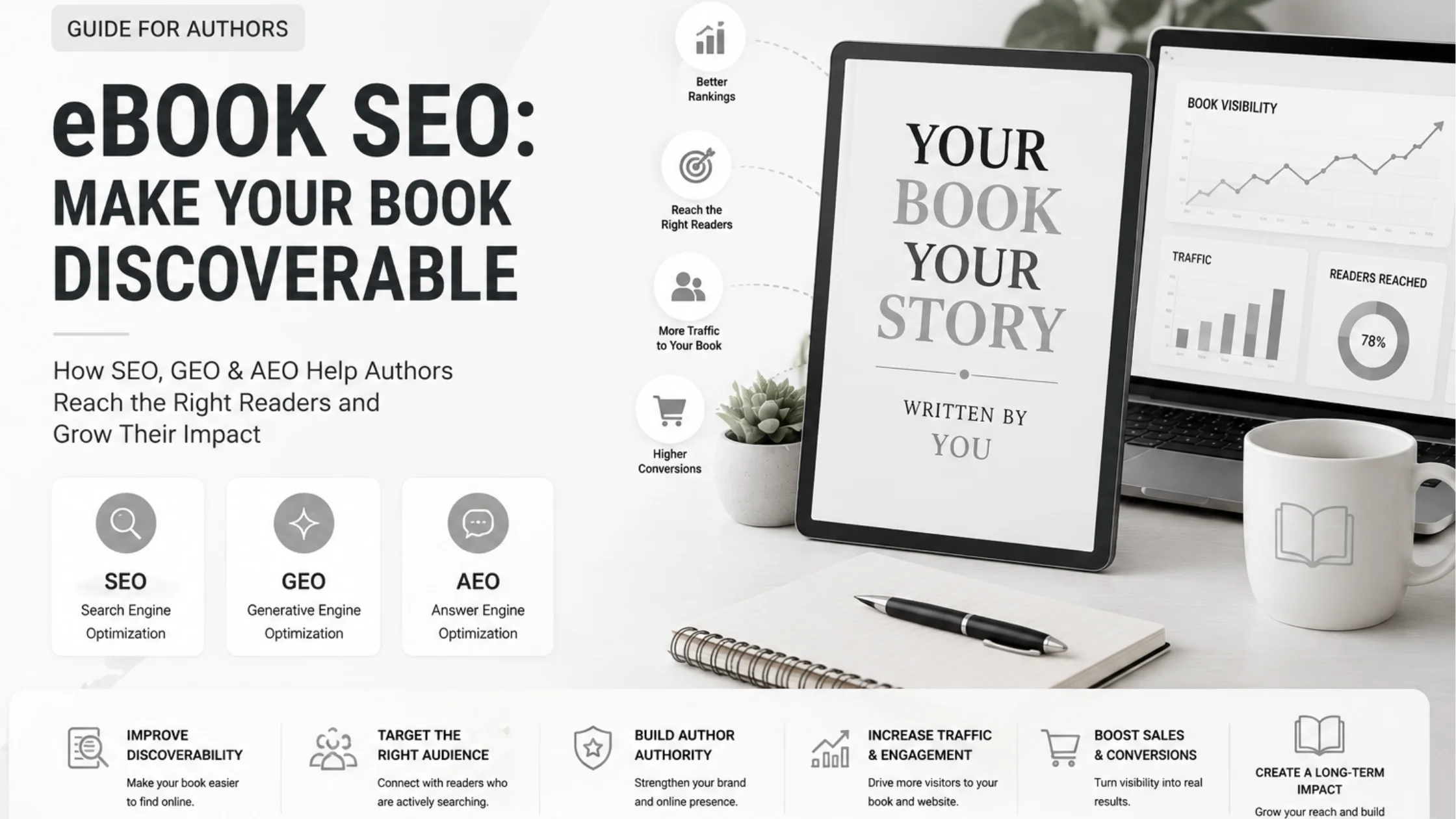
Writing a great eBook is only half the journey.
The other half is helping the right readers find it.
You can spend months writing, editing, designing, and publishing an eBook, but if potential readers cannot discover it when they search for books, topics, solutions, or authors like you, your book may struggle to gain visibility.
This is where eBook SEO becomes important.
eBook SEO is the process of optimizing your book’s online presence so that search engines, online bookstores, and increasingly AI-powered search systems can better understand what your book is about and connect it with relevant readers.
For authors publishing through platforms such as Amazon Kindle Direct Publishing (KDP), this includes paying attention to your book’s title, subtitle, description, keywords, categories, author information, and overall metadata. Amazon itself states that relevant keywords can help make a book easier for customers to find in the Amazon Store.
But today’s publishing environment goes beyond traditional SEO.
Authors should also understand:
- SEO — Search Engine Optimization
- GEO — Generative Engine Optimization
- AEO — Answer Engine Optimization
These three approaches overlap, but they serve different discovery environments.
The goal is not to manipulate search engines or stuff keywords into your book description. The goal is to create clear, useful, accurate, and discoverable information that helps readers and the systems helping readers find information understand your book.
Google’s current guidance emphasizes people-first, useful content and notes that the same fundamentals remain important as Search expands into AI experiences.
For authors, this means SEO should be considered before, during, and after publishing not as an afterthought.

What Is eBook SEO?
eBook SEO is the process of optimizing an eBook’s metadata, online content, and digital presence to improve discoverability for relevant searches.
Think about what happens when someone wants to find a book.
They might search:
“best books about overcoming anxiety”
Or:
“self-help book for building confidence”
Or:
“historical romance books set in England”
Or:
“how to start a small business book”
Or:
“children’s books about friendship”
Readers don’t necessarily search for your exact book title.
They often search for a topic, problem, genre, interest, or outcome.
If your book’s metadata clearly communicates those things, it becomes easier for platforms and readers to understand where your book belongs.
Amazon specifically recommends that authors choose keywords that accurately describe the book’s content and reflect the words customers are likely to use when searching.
That is the foundation of eBook SEO.
Why Is SEO Important for an eBook?
The biggest reason is simple:
A book cannot sell if potential readers cannot discover it.
Publishing your eBook puts it on the market.
SEO helps improve the chances that people searching for relevant topics can find it.
Consider two books.
Book A
The description says:
“This book is a powerful and inspiring journey that will change your life.”
It sounds positive, but it doesn’t tell search systems or readers much about the actual subject.
Book B
The description clearly explains:
“This practical self-help guide teaches young adults how to build confidence, overcome self-doubt, develop healthier habits, and create realistic personal goals.”
The second description gives readers—and search systems—much more useful information.
It communicates:
- Audience
- Topic
- Problems
- Benefits
- Subject matter
- Search intent
That clarity matters.
Google describes SEO as helping search engines understand your content and helping users discover your site through search.
The same basic principle applies to an author’s broader online presence.
SEO Can Help Your Book Reach the Right Audience
SEO is not simply about getting more visibility.
It is about getting relevant visibility.
Suppose you wrote a book about beginner photography.
You don’t necessarily want your book appearing in front of everyone searching for “books.”
You want people searching for things such as:
- photography for beginners
- beginner photography guide
- learn photography
- camera basics
- photography composition
- taking better photographs
These searches reveal something about the reader’s intent.
The person searching for “beginner photography guide” may be much more likely to consider your book than someone searching for a completely unrelated topic.
This is why keyword research should start with the reader, not the search engine.
What Is the Difference Between SEO, GEO, and AEO?
Authors increasingly hear three terms: SEO, GEO, and AEO.
Understanding the difference can help you create a stronger digital publishing strategy.
SEO: Search Engine Optimization
SEO focuses primarily on improving the discoverability of your content in traditional search engines.
For an author, this may involve optimizing:
- Author website pages
- Blog posts
- Book landing pages
- Book descriptions
- Page titles
- Meta descriptions
- Image alt text
- Internal links
- Structured data
- Relevant keywords
The objective is to make content easier for search engines to understand and users to discover.
GEO: Generative Engine Optimization
Generative Engine Optimization (GEO) refers to optimizing information so that it can be understood and potentially surfaced by AI-powered search and generative systems.
Instead of only asking:
“How can I appear in Google search results?”
an author or publisher can also consider:
“How can I make my information clear enough for AI-powered systems to understand, summarize, and connect with relevant queries?”
This makes clarity, context, originality, and factual consistency increasingly important.
Google’s guidance for AI search specifically emphasizes unique, valuable content for people rather than content created primarily to manipulate rankings. It also recommends ensuring that content is accessible to search systems and that structured data accurately matches visible page content.
There is no secret GEO formula that guarantees inclusion in an AI answer.
Instead, the best approach is to create useful content that clearly establishes:
- Who the author is
- What the book is about
- Who the book is for
- What problems it addresses
- What readers can learn
- What makes the book different
- Where the book is available
AEO: Answer Engine Optimization
Answer Engine Optimization (AEO) focuses on creating content that directly answers questions.
This is particularly relevant to authors because potential readers ask questions throughout the buying journey.
For example:
- What is this book about?
- Who should read this book?
- Is this book suitable for beginners?
- What genre is the book?
- What will I learn from this book?
- How long is the book?
- Where can I buy the book?
- Is this book available as an eBook?
- Who wrote the book?
AEO encourages authors to provide direct, concise answers to relevant questions.
Instead of hiding the answer deep inside a page, structure the content so the important information is easy to identify.
Why Authors Should Care About SEO, GEO, and AEO
Readers are no longer discovering books through only one channel.
A potential reader might:
- Search Google.
- See an author’s website.
- Ask an AI tool about the book.
- Search the title on Amazon.
- Read reviews.
- Visit the author’s social media.
- Return to Amazon and purchase the book.
Your book’s digital presence therefore needs to communicate a consistent story across multiple platforms.
If your website says your book is a “business leadership guide,” Amazon calls it “entrepreneurship,” and your social media describes it as a “personal development book,” you may create unnecessary ambiguity.
Consistent information makes your author brand easier to understand.
Amazon itself recommends keeping important book details consistent across editions and formats.
The Most Important eBook SEO Elements
1. Book Title
Your title is one of the most important pieces of book metadata.
It should be:
- Accurate
- Memorable
- Relevant
- Easy to understand
- Consistent with the cover
Do not force keywords into the title simply because you think they will help search visibility.
Amazon identifies titles as one of the most frequently used search attributes and requires the title field to contain the actual title of the book.
Your title should serve the reader first.
2. Subtitle
For nonfiction especially, the subtitle can provide valuable context.
For example:
The Confident Entrepreneur
could become:
The Confident Entrepreneur: A Practical Guide to Building a Successful Small Business
The subtitle tells readers much more about the book.
It can communicate:
- Topic
- Audience
- Benefit
- Scope
- Search intent
However, the subtitle should accurately represent the book rather than becoming a collection of unrelated keywords.
3. Book Description
Your book description has two jobs:
Help readers understand the book.
Give them a reason to continue reading or buy it.
A strong description should naturally communicate:
- The book’s main subject
- The target audience
- The reader’s problem
- The book’s approach
- Key benefits
- Genre or category
- What makes the book distinctive
Don’t write:
“This amazing, bestselling, life-changing book is the best book for everyone.”
Instead, clearly explain what the book actually delivers.
Amazon’s metadata guidance describes the book description as a way to summarize the story and characters and persuade a casual browser to buy.
4. Keywords
Keywords connect reader searches with your book’s subject.
For example, a book about beginner gardening might target concepts such as:
- beginner gardening
- vegetable gardening
- container gardening
- growing vegetables
- gardening for beginners
The exact keywords should depend on your genre and audience.
Amazon currently allows up to seven keyword fields for KDP titles and recommends using relevant words or phrases that reflect how customers search.
The important word here is relevant.
Don’t use keywords simply because they are popular.
A keyword that attracts the wrong audience does not create meaningful discoverability.
5. Categories
Categories function like digital shelves.
Amazon describes categories as sections of its store that organize books according to genres and topics.
Imagine walking into a bookstore.
A romance novel placed in the gardening section is unlikely to reach the correct audience.
The same principle applies digitally.
Choose categories that genuinely describe your book.
Amazon recommends balancing popularity and relevance rather than selecting categories simply because they appear attractive.
6. Author Name and Author Brand
Your author’s name is also part of discoverability.
If you publish several books, consistency becomes particularly important.
For example:
John Michael Smith
should not randomly become:
J. M. Smith
on another edition unless there is a deliberate branding reason.
Amazon recommends maintaining consistent author and series information across editions because features such as Author Pages and Series Pages rely on consistent information.
Authors should also build an online identity around their name.
That can include:
- Author website
- Author bio
- Book pages
- Social profiles
- Interviews
- Guest articles
- Podcast appearances
- Publishing profiles
Over time, these signals can help create a stronger digital footprint.
7. Author Website
If you are serious about your author career, having your own website can be valuable.
Your website gives you a digital property that you control.
A professional author website can include:
- Home page
- About the author
- Book pages
- Individual book descriptions
- Blog
- Media or press page
- Contact page
- Purchase links
- Newsletter signup
- Reviews or testimonials where appropriate
Each book should ideally have its own dedicated page.
That page can explain:
What is the book about?
Who is it for?
What will readers learn or experience?
Where can readers buy it?
This creates a useful information hub for both readers and search systems.
8. Blog Content
Blogging can support an author’s SEO strategy by allowing you to answer questions related to your book’s subject.
For example, if you wrote a book about personal finance, your website might publish articles about:
- How to create a monthly budget
- How to save money as a beginner
- Common financial mistakes
- How emergency funds work
- How to reduce unnecessary expenses
Those articles can attract people interested in the same subject as your book.
The goal isn’t to turn every blog post into an advertisement.
Instead, provide genuine value and naturally connect relevant readers to your book.
Google’s guidance specifically emphasizes creating helpful, reliable, people-first content rather than content designed primarily to attract search-engine traffic.
9. Internal Linking
If your author website has multiple pages, connect them logically.
For example:
Blog article → Book page → Author page → Purchase page
This helps visitors navigate your website.
It also creates a clearer relationship between your content.
Suppose you publish an article titled:
10 Ways to Improve Your Public Speaking Skills
Inside that article, you could naturally link to your book:
The Complete Guide to Public Speaking
This creates a useful path from informational content to your book.
10. Images and Alt Text
Visual content also matters.
Your book page might include:
- Book cover
- Author photograph
- Interior previews
- Illustrations
- Infographics
- Promotional graphics
Images should be relevant and properly labeled.
For example, instead of a generic image filename such as:
IMG1234.jpg
use something descriptive where appropriate:
beginner-photography-guide-book-cover.jpg
Alt text should describe the image accurately for accessibility and context.
Google’s guidance for AI search also recommends supporting text with high-quality images and videos where appropriate.
11. Structured Data
Structured data is another technical SEO element authors and publishers should understand.
It provides machine-readable information about a webpage.
Depending on the page, structured data can help search systems understand entities and content more clearly.
For example, a book page may communicate information about:
- Book title
- Author
- ISBN
- Publisher
- Publication date
- Image
- Description
The important rule is accuracy.
Google specifically states that structured data should match the visible content on the page.
Structured data is not a magic ranking shortcut.
It is a way to help systems interpret information.
How AEO Can Help Authors
AEO becomes especially useful when you build pages around the questions readers actually ask.
Instead of writing one giant block of promotional text, create useful sections such as:
What is this book about?
A short, direct answer.
Who should read this book?
A specific description of the ideal audience.
What will readers learn?
A concise list of major takeaways.
What genre is this book?
A clear genre classification.
Where can I buy the book?
A straightforward purchasing section.
This structure makes information easier for humans to scan and easier for automated systems to interpret.
How GEO Can Help Build Author Authority
Generative search systems increasingly need context.
If an AI system encounters information about an author, it benefits from clear relationships between:
Author → Book → Topic → Expertise → Website → Supporting Content
For example:
An author’s website says:
Sarah Johnson is a financial educator and author of Smart Money for Beginners.
The book page explains the book’s subject.
The author’s blog publishes articles about budgeting and personal finance.
The author appears in relevant interviews and publications.
The information is consistent across platforms.
Together, these create a much clearer digital identity than a single Amazon listing alone.
This is one reason authors should think beyond their book’s product page.
What Authors Should NOT Do for SEO
SEO does not mean stuffing keywords everywhere.
Avoid:
- Repeating the same keyword unnaturally
- Using unrelated popular keywords
- Adding competitor author names to metadata
- Making false bestseller claims
- Writing descriptions for search engines instead of readers
- Creating dozens of low-quality AI-generated articles
- Using misleading categories
- Hiding keywords in content
- Publishing duplicate content everywhere
Amazon specifically prohibits misleading and unrelated keywords and categories.
Google also warns against creating content primarily for search-engine traffic rather than people.
The better strategy is simple:
Be relevant. Be accurate. Be useful. Be consistent.
When Should an Author Start SEO?
The ideal time is before publication.
Don’t wait until six months after your book launches.
SEO can be incorporated during the publishing process.
Before Publishing
Research:
- Target readers
- Search terms
- Genre
- Subgenre
- Reader questions
- Competing books
- Relevant categories
During Publishing
Optimize:
- Title
- Subtitle
- Description
- Keywords
- Categories
- Author information
- Cover metadata
- Book website
After Publishing
Continue building:
- Blog content
- Author website authority
- Social presence
- Reviews
- Interviews
- Backlinks
- Supporting articles
- Reader engagement
SEO is not a one-time checkbox.
It is an ongoing discoverability strategy.
An eBook SEO Checklist for Authors
Before publishing your eBook, review the following:
- [ ] Is the book title accurate and memorable?
- [ ] Does the subtitle clearly communicate the subject?
- [ ] Is the book description written for real readers?
- [ ] Have you researched relevant search terms?
- [ ] Are your keywords accurate?
- [ ] Are your Amazon categories relevant?
- [ ] Is your author name consistent?
- [ ] Is your book cover professionally designed?
- [ ] Does your website have a dedicated book page?
- [ ] Does the book page clearly explain who the book is for?
- [ ] Have you answered common reader questions?
- [ ] Are your images properly optimized?
- [ ] Is your website mobile-friendly?
- [ ] Are relevant pages internally linked?
- [ ] Is structured data implemented correctly where appropriate?
- [ ] Is your information consistent across platforms?
- [ ] Are you publishing useful supporting content?
- [ ] Are you avoiding keyword stuffing?
- [ ] Are your claims accurate and verifiable?
Does SEO Guarantee Book Sales?
No.
This is an important distinction.
SEO can improve discoverability, but discoverability does not automatically equal sales.
Amazon itself notes that search results are dynamic and that it cannot guarantee a book will appear near the top of search results.
A successful book needs more than keywords.
You also need:
- A strong book
- Professional editing
- A compelling cover
- A clear description
- Competitive positioning
- Positive reader response
- Appropriate pricing
- Effective marketing
- A relevant audience
Think of SEO as helping more of the right people discover the opportunity to buy your book.
The book itself still needs to convince them.
Why Professional eBook SEO Matters
Many authors know how to write a book.
Far fewer understand how to optimize its entire digital presence.
A professional publishing team can help authors look at the book from both perspectives:
Author perspective:
“What did I write?”
Reader perspective:
“What am I looking for?”
Search perspective:
“What information helps me understand this book?”
AI/search perspective:
“How can this information be interpreted accurately?”
Bringing these perspectives together can create a much stronger publishing strategy.
At InkNova Publishers, SEO can be considered alongside the broader publishing process so that an author’s book is not treated as simply a manuscript that needs to be uploaded.
The objective should be to build a professional publishing presence around the book—from its content and presentation to its online discoverability.
Final Thoughts: Make Your eBook Easier to Discover with Inknova Publishers
Publishing an eBook is only the beginning. In a crowded digital publishing market, authors also need to think about how readers will discover their book.
That is where eBook SEO can make a difference.
From keyword research and metadata optimization to content structuring, online visibility, and a reader-focused SEO strategy, the right optimization can help position your eBook more effectively in front of its intended audience. However, SEO should never be about simply adding keywords. It should be about understanding your readers, their search behavior, and the platforms where they are looking for books like yours.
At Inknova Publishers, we provide dedicated eBook SEO and Search Engine Optimization services designed specifically for authors and digital books. Our approach includes eBook keyword optimization, meta optimization, content structuring, link-building strategies, and online visibility efforts tailored to the book and its target audience.
Explore Inknova Publishers’ eBook SEO Services
Whether you’re preparing to publish your first eBook or already have a published title that needs greater online visibility, Inknova Publishers can help you develop a more focused SEO strategy around your book.
Your book deserves more than a place on a digital shelf. It deserves to be discovered by the readers who are looking for it.
Ready to improve your eBook’s online visibility? Contact Inknova Publishers and take the next step toward making your book easier to find, understand, and connect with the right audience.
