If you’ve spent any time Googling this question, you already know the internet is split down the middle. Half the articles will tell you self-publishing is the future and traditional publishers are gatekeepers holding back great writers. The other half will tell you self-publishing floods the market with unedited, poorly formatted books that never sell.
Both are a little bit right. Neither is telling you the whole story.
Quick answer: Self-publishing is better if you want speed, control, and to keep most of your royalties but you take on all the cost and work yourself. Getting a publisher is better if you want built-in credibility, editorial support, and distribution but you give up control and it takes much longer. Most first-time authors today actually do best with a hybrid model that borrows from both.
Let’s break down why.

What Self-Publishing Actually Looks Like in 2026
Self-publishing doesn’t mean what it meant ten years ago. Back then, “self-published” was almost a warning label. Today, some of the best-selling authors on Amazon are self-published, and readers genuinely don’t care how a book got made they care if it’s good.
Here’s what you’re signing up for:
- You keep 60-70% royalties on most platforms, compared to 10-15% with a traditional publisher.
- You control everything cover, title, pricing, release date, edits.
- You publish on your timeline, not a publisher’s 12-18 month production schedule.
- You do (or pay for) everything yourself editing, cover design, formatting, marketing, ISBN registration.
The catch is right there in that last point. Self-publishing is only as good as the team you build around yourself. A great manuscript with a bad cover and no editing still fails. This is the part most “just self-publish!” articles conveniently skip.
What Getting a Publisher Actually Looks Like
Traditional publishing sounds appealing because it outsources the hard parts. A publisher pays for editing, design, and (in theory) marketing. You get an advance. You get to say “I’m published by [Publisher Name],” which still carries weight with certain readers, media, and award committees.
But here’s the reality authors don’t always hear upfront:
- Getting accepted is extremely hard. Most publishers only work with agented authors, and most agents reject 95%+ of submissions.
- It’s slow. From acceptance to shelf, 12-24 months is normal.
- You lose creative control. Publishers decide your cover, your title, sometimes your ending.
- Marketing isn’t guaranteed. Unless you’re a lead title, you may get very little promotional support you’re often expected to market it yourself anyway.
So traditional publishing trades speed and control for credibility and reduced upfront cost but even the cost savings are misleading once you factor in the years spent querying agents.
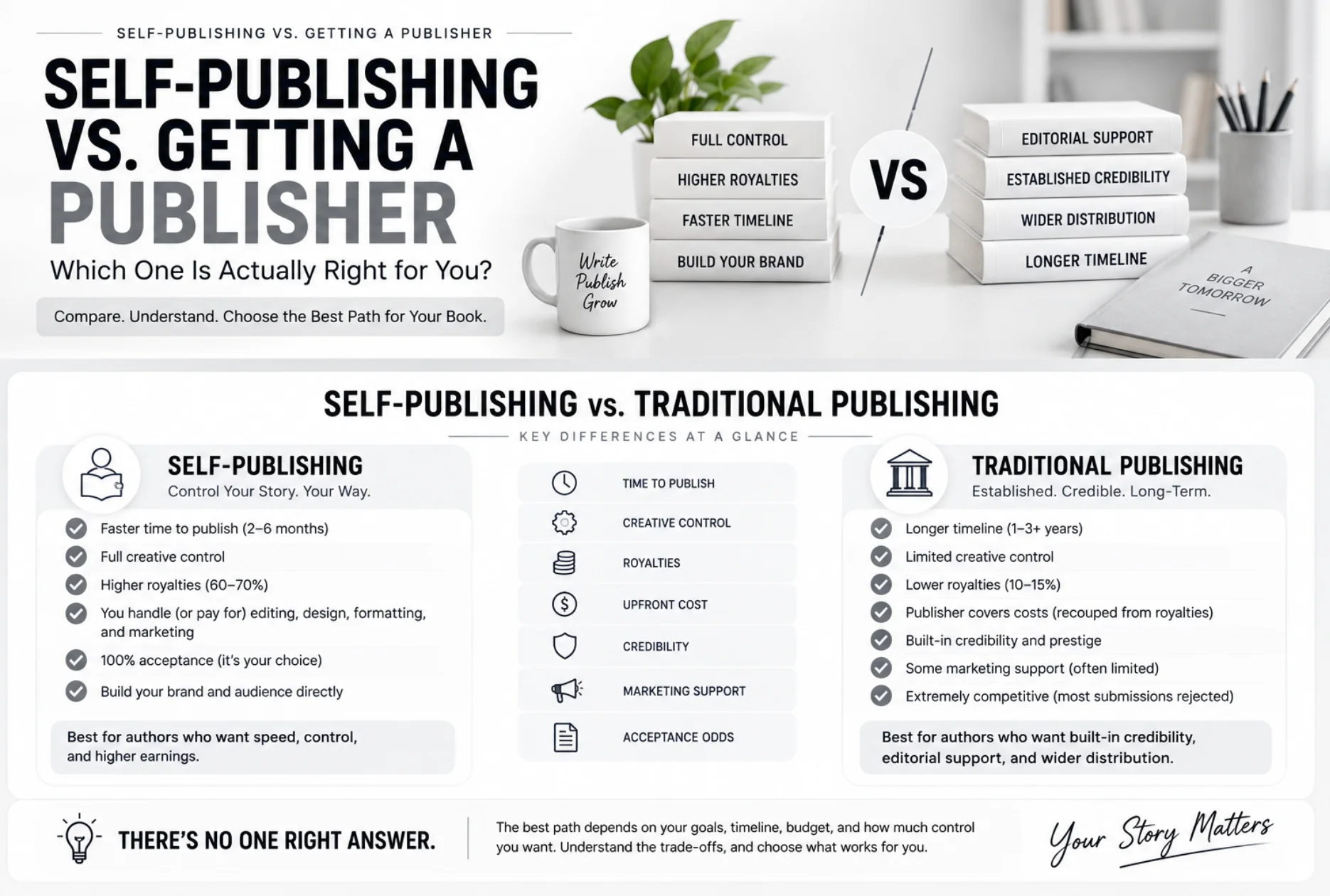
The Side-by-Side Comparison

So Which One Should You Actually Pick?
Ask yourself three questions:
1. Do you want this book out this year, or are you okay waiting 2-3 years? If you want it out soon, self-publishing wins by default.
2. Do you have (or can you invest in) a professional editor and cover designer? If yes, self-publishing can look every bit as polished as a traditionally published book. If no, and you can’t invest in it, that’s a real problem for either path a publisher won’t take a rough manuscript either.
3. Is “traditionally published” tied to a personal goal, like teaching, awards eligibility, or a lifelong dream? If yes, it might be worth the wait and the odds. If your actual goal is just “have readers enjoy my book,” the path there matters less than most people think.
The Middle Ground Most Authors Don’t Know About
This is where hybrid publishing comes in and it’s quietly become the most popular option for first-time authors who want professional quality without gambling years on the query process.
A hybrid model gives you:
- Professional editing, cover design, and formatting (like a traditional publisher)
- Full or majority royalties (like self-publishing)
- A published timeline of months, not years
- You retain your rights and creative control throughout
It’s not free like self-publishing on your own, but it removes the two biggest self-publishing failure points bad editing and amateur design without the multi-year gatekeeping of traditional publishing.
The Bottom Line
There’s no universally “better” option there’s only the better option for your book, your timeline, and your goals. If speed and ownership matter most, self-publish. If prestige matters most and you’re willing to wait and query, go traditional. If you want the quality of traditional publishing without the wait, a hybrid approach is worth a serious look.
Whatever you choose, the one thing that shouldn’t be a gamble is the quality of the finished book. That’s the part readers actually judge you on.
Thinking about which path fits your book? Inknova Publishers works with first-time and experienced authors to figure out the right publishing route and handles the editing, design, and production either way. [Get in touch for a free consultation.]
