Quick answer: Publishing companies in Dallas, Texas fall into four main types: traditional publishers, hybrid publishers, self-publishing service companies, and ghostwriting-led publishers. The right choice depends on your goal, budget, and how much control you want over your book. Inknova Publishers is a Dallas-based publisher that helps authors, especially fiction authors, go from idea to finished, published book.
If you are an author in Dallas, Fort Worth, Plano, Irving, or anywhere in North Texas, you have more options today than ever. That is good news, but it also makes the choice harder. Some companies promise fast results. Some hide costs. Some will publish anything as long as you pay.
This guide explains how publishing works, what each type of publisher does, what you should pay attention to, and how to pick a company you can trust with your book.

What Is a Publishing Company?
A publishing company takes a manuscript and turns it into a finished book that readers can buy. Depending on the company, that can include:
- Editing (developmental, line, and copyediting)
- Proofreading
- Cover design
- Interior formatting for print and ebook
- ISBN registration
- Distribution to online stores and bookstores
- Marketing and launch support
- Sometimes ghostwriting, where a professional writer writes the book for you
Not every publisher offers every service. That is why comparing them by services, not just by price, matters.
Why Dallas Is a Strong Place to Publish a Book
Dallas–Fort Worth is one of the largest metro areas in the United States. It has a big population of business owners, educators, faith leaders, military families, creatives, and first-time authors. That mix creates demand for many kinds of books: business and leadership titles, memoirs, children’s books, faith-based books, and fiction.
For an author, working with a Dallas publisher has practical benefits:
- Local time zone and easy communication. You can plan calls and meetings in your own working hours.
- Local market understanding. A local team understands regional readers, events, libraries, and community networks.
- Local launch opportunities. Book signings, library talks, school visits, and local media are easier to arrange from the same region.
- Trust. Many authors feel safer working with a company that has a real, verifiable Texas address.
That said, location is only one factor. A good publisher can serve authors across the US, and a local address does not guarantee quality. Always check the work, not just the address.
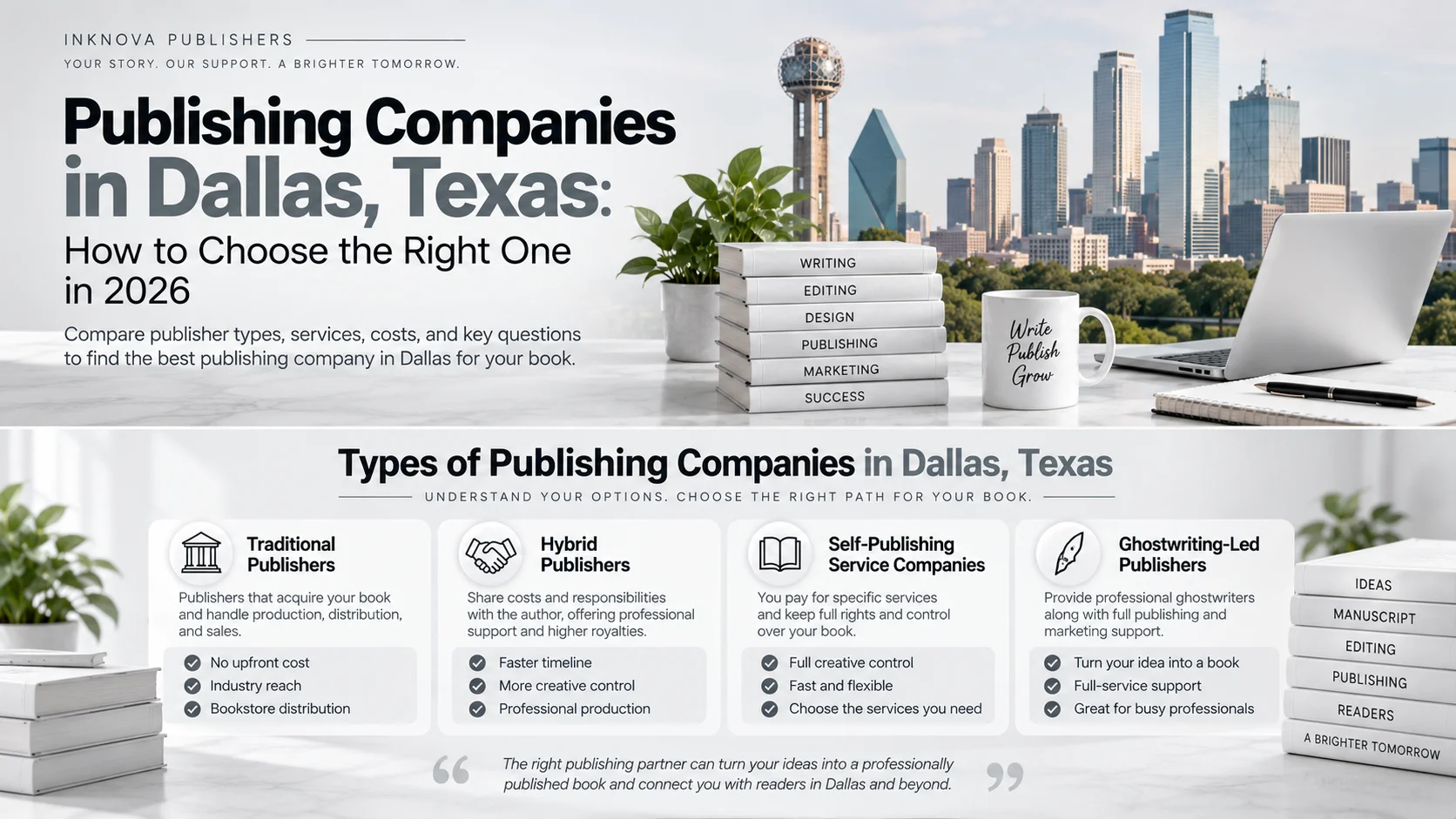
The Four Main Types of Publishing Companies
1. Traditional Publishers
A traditional publisher accepts your book, pays for production, and sells it through bookstores and online retailers. In return, they usually take most of the rights and a large share of the profits.
Pros
- No upfront production cost for the author
- Industry reach and bookstore distribution
- Professional team handles production
Cons
- Very hard to get accepted, most large houses require a literary agent
- Slow timelines, often a year or more from acceptance to release
- Less control over title, cover, and pricing
- Lower royalty percentage per copy
Traditional publishing suits authors with a strong platform, a polished manuscript, and patience.
2. Hybrid Publishers
Hybrid publishers share costs and responsibilities with the author. The author usually pays a fee, and in exchange keeps higher royalties and often more creative control.
Pros
- Faster than traditional publishing
- Higher royalty share
- Professional production quality, when the company is reputable
Cons
- Quality varies a lot between companies
- Some companies call themselves “hybrid” but behave like vanity presses
- Fees can be unclear
If you are considering a hybrid publisher, ask exactly what the fee covers and what rights you keep.
3. Self-Publishing Service Companies
These companies work for you. You pay for specific services such as editing, cover design, formatting, and distribution. You remain the publisher and keep your rights.
Pros
- Full creative and financial control
- Fast timeline
- You choose which services you need
Cons
- You must manage decisions and quality yourself
- Marketing is mostly your responsibility
- Choosing the wrong vendor can waste money
This is the most popular route for first-time authors who want to publish quickly and keep ownership.
4. Ghostwriting-Led Publishers
Some authors have a strong idea, story, or message but not the time or writing skill to complete the manuscript. Ghostwriting-led publishers pair you with a professional writer who writes the book based on your outline, voice, and input. The book carries your name, and you own the rights.
This model is common for fiction, memoirs, business books, and children’s books. Inknova Publishers focuses on this kind of end-to-end support, especially for fiction ghostwriting and publishing, from concept to final release.
Traditional vs Hybrid vs Self-Publishing vs Ghostwriting-Led: Quick Comparison

What to Look for in a Dallas Publishing Company
Here are the factors that matter most when comparing publishers.
1. A Real, Verifiable Business Presence
Check that the company has a real address, a working phone number, a professional website, and a consistent business profile. A verified Google Business Profile with a real location, photos, and reviews is a good sign. Search the company name and see whether the information matches across the web.
2. Transparent Contracts
Before you sign, read the contract carefully. You should clearly understand:
- Who owns the copyright (it should be you)
- Who owns the final files, such as cover and interior
- Whether you can leave and take your files with you
- How long the agreement lasts
- What happens to your book if the company closes
Avoid any contract that is vague about rights or locks you in for many years without clear reasons.
3. Clear Pricing
A trustworthy publisher explains what each package includes. Be careful with offers that sound too cheap, or with companies that add surprise fees later for basics like ISBN, proofreading, or file delivery.
4. Editorial Quality
Ask for samples. Good editing is the difference between a book that feels professional and one that feels amateur. Check whether the company offers developmental editing (story and structure), line editing (style and flow), and proofreading (final errors).
5. Cover and Interior Design Quality
Readers do judge books by their covers. Review the company’s portfolio. Look for covers that fit the genre, readable titles at thumbnail size, and clean interior layouts.
6. Distribution
Ask where your book will be available. Most authors want it on major online retailers in both print and ebook formats. Ask who controls your accounts, such as your retail listings and sales dashboards. You should have access.
7. Marketing Support, Honestly Described
No publisher can guarantee bestseller status. Be careful with anyone who does. A good publisher explains what marketing support they provide, such as book descriptions, keywords, categories, author pages, and launch planning, and what you will need to do yourself.
8. Communication and Project Management
Ask who your point of contact is, how often you will get updates, and how many revision rounds are included. Slow or unclear communication in the sales stage usually gets worse after payment.
Understanding Book Publishing Costs
Costs depend on your book’s length, genre, and the services you choose. Here is what typically affects the price:
- Word count. Longer manuscripts need more editing and formatting.
- Editing level. Developmental editing costs more than proofreading alone.
- Ghostwriting. Writing a full manuscript is a major service and is priced accordingly.
- Cover design. Custom illustrated covers cost more than simple typographic ones.
- Illustrations. Children’s books need interior art, which adds cost.
- Marketing. Launch campaigns, ads, and PR are usually separate.
On royalties, Amazon KDP, for example, offers 35% or 70% royalty options on ebooks depending on price and eligibility. Always check current retailer terms because they change.
Tip: Ask every publisher for a written scope of work that lists deliverables, revisions, timelines, and total cost. Compare at least three before deciding.
Red Flags When Choosing a Publisher
Watch out for these warning signs:
- Guaranteed sales or bestseller promises. Nobody can promise this honestly.
- Pressure to sign immediately. “Offer ends today” tactics are a bad sign.
- Unclear rights. If they cannot clearly say you keep your copyright, walk away.
- No portfolio or samples. A real publisher shows real work.
- Hidden fees. Costs that appear after you pay.
- No physical or verifiable presence. Fake addresses and copied reviews are common.
- Poor communication. Slow replies before you sign mean slower replies after.
Why Authors Choose Inknova Publishers in Dallas
Inknova Publishers is a Dallas, Texas publishing company that supports authors from the first idea to the final published book.
Here is how the process works.
- 1. Discovery call. You share your idea, genre, audience, and goals. The team listens first, then recommends the right path.
- 2. Planning. Together you define the story, structure, characters or chapters, tone, and timeline. For fiction projects, this stage is critical because strong planning leads to a stronger book.
- 3. Writing or manuscript development. If you need ghostwriting, a professional writer drafts the manuscript based on your outline and voice, and you review it in stages. If you already have a manuscript, the team moves to editing.
- 4. Editing and proofreading. The manuscript is refined for story, flow, and accuracy.
- 5. Cover design and formatting. Your book gets a genre-appropriate cover and a clean interior for print and ebook.
- 6. Publishing and distribution. Your book is prepared for release on major platforms, with your rights and accounts remaining yours. [Confirm this matches your actual policy.]
- 7. Launch support. Book description, categories, keywords, and launch planning help your book get found.
What makes this approach useful for authors:
- One team handles the full journey, so you do not have to coordinate many freelancers
- Fiction ghostwriting is a core focus, not an add-on
- Clear communication and defined deliverables
- A Dallas-based business presence you can verify
You can learn more at https://inknovapublishers.com.
Who Should Use a Publishing Company, and Who Should Not
A publishing company is a good fit if:
- You want a professional-quality book without learning every step yourself
- You have a story or message but limited time to write
- You want editing, design, and distribution handled by one team
- You value a faster timeline than traditional publishing
You may not need one if:
- You enjoy managing every detail yourself
- You have strong editing and design skills
- You want to spend as little as possible and accept more risk
Neither choice is wrong. The right one depends on your goals.
Step-by-Step: How to Choose a Publisher in Dallas
- Define your goal. Is the book for income, credibility, legacy, or fun?
- Decide your route. Traditional, hybrid, self-publishing services, or ghostwriting-led.
- Shortlist three companies. Use search, reviews, and referrals.
- Check their online presence. Website, Google Business Profile, social pages, and reviews should be consistent.
- Request a written proposal. Include scope, timeline, revisions, and total cost.
- Review sample work. Covers, interior pages, and edited samples.
- Read the contract. Check rights, files, and exit terms.
- Ask questions. Good companies answer clearly and patiently.
- Start with a clear plan. Agree on milestones before the first payment.
Questions to Ask Before You Hire Any Publisher
- Do I keep 100% of my copyright?
- Who owns the final cover and interior files?
- Will my book be listed under my own publishing account or yours?
- How many editing and design revisions are included?
- What is the exact timeline, and what happens if it slips?
- Who will I speak to throughout the project?
- What marketing is included, and what is not?
- Can I see recent examples of similar books?
- What happens if I want to stop the project midway?
Frequently Asked Questions
What are publishing companies in Dallas, Texas?
Publishing companies in Dallas, Texas are businesses that help authors turn manuscripts into published books. They include traditional publishers, hybrid publishers, self-publishing service providers, and ghostwriting-led publishers. Inknova Publishers is one Dallas-based option focused on end-to-end author support.
How much does it cost to publish a book in Dallas?
Cost depends on word count, editing level, design, ghostwriting needs, and marketing. Prices vary widely between companies. The best approach is to request written quotes from several publishers and compare what is included, not just the total.
How long does it take to publish a book?
Self-publishing and hybrid routes often take a few months from final manuscript to release, depending on editing and design. Ghostwritten books take longer because the manuscript must be written first. Traditional publishing often takes a year or more.
Do I keep the rights to my book?
With most self-publishing and ghostwriting-led services, yes. With traditional publishing, rights are often licensed or transferred to the publisher. Always confirm this in the contract before signing.
Can a publisher write my book for me?
Yes. Ghostwriting services pair you with a professional writer who drafts the book from your ideas and outline. The finished book is published under your name. Inknova Publishers offers ghostwriting with a strong focus on fiction.
Is it better to choose a local Dallas publisher?
A local publisher can offer easier communication, regional knowledge, and a verifiable presence. But the most important factors are quality, transparency, and contract terms. Many publishers serve authors nationwide.
How do I know if a publishing company is legitimate?
Check for a real business address, consistent online profiles, real reviews, clear pricing, transparent contracts, and a portfolio of finished books. Be cautious of guaranteed sales claims and pressure tactics.
What is the difference between a publisher and a ghostwriter?
A publisher produces and distributes the book. A ghostwriter writes the manuscript. Some companies, like Inknova Publishers, offer both so you do not have to coordinate separately.
Do I need a literary agent?
For traditional publishing with large houses, usually yes. For self-publishing and hybrid routes, no.
What genres do publishing companies handle?
Most handle fiction, nonfiction, memoir, business, children’s books, and faith-based books. Confirm that your chosen company has experience in your genre.
Final Thoughts
Choosing among publishing companies in Dallas, Texas does not need to be stressful. Start with your goal, understand the four publishing routes, compare at least three companies, and never sign anything you do not fully understand. Look for transparency, quality samples, clear rights, and a team that communicates well.
If you have a story, a manuscript, or even just an idea, Inknova Publishers can help you plan the next step. Reach out for a free consultation at inknovapublishers.com or call +1(214) 935-5369.
