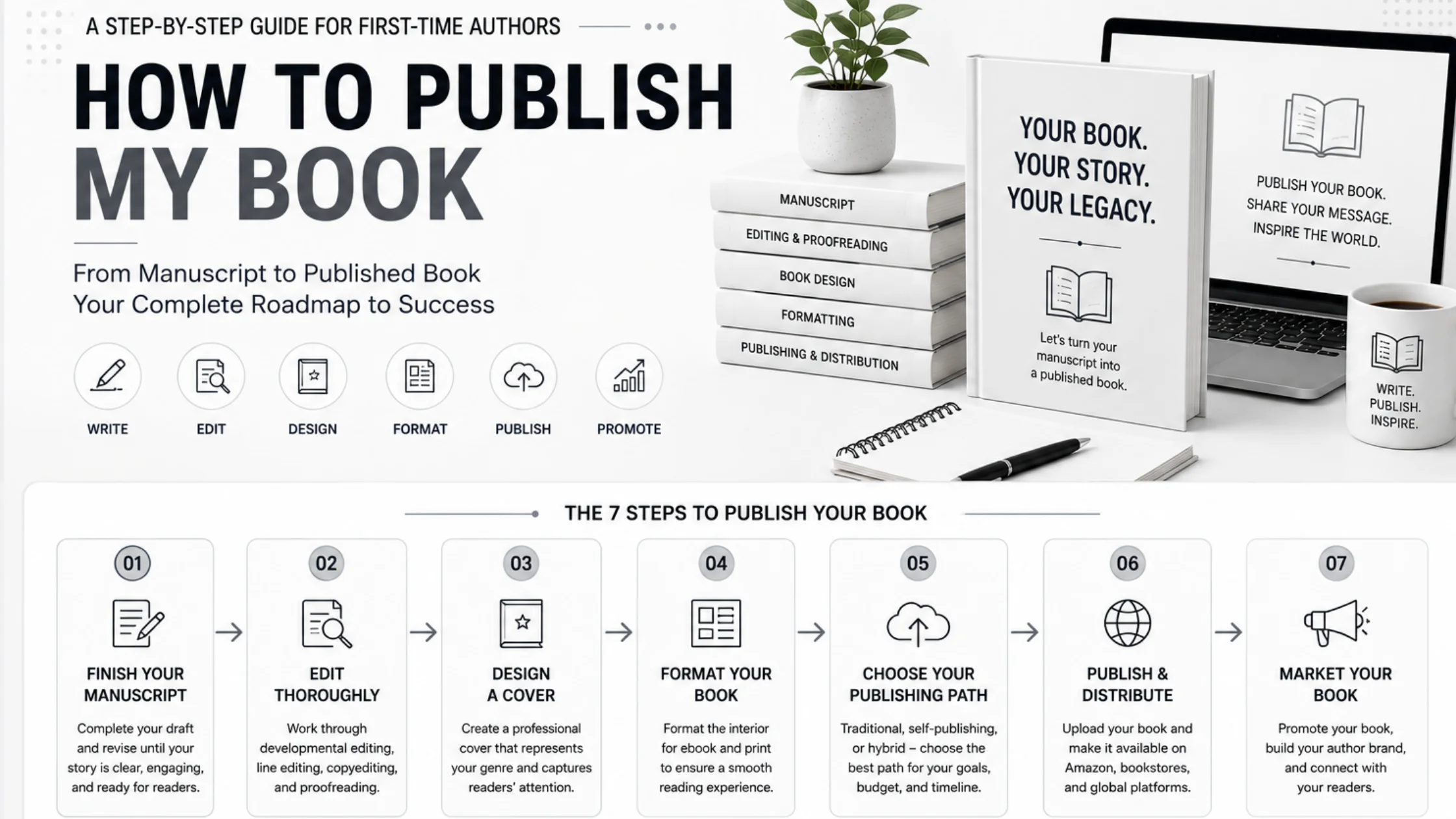
Quick Answer: To publish your book, you need a finished, professionally edited manuscript, a cover design, interior formatting, and a distribution method either traditional publishing (submit to agents/publishers), self-publishing (platforms like Amazon KDP or IngramSpark), or hybrid publishing (companies like Inknova Publishers that handle editing, design, and distribution for you). Most first-time authors finish the process in 3–6 months once the manuscript is ready.
You’ve typed “how do I publish my book” into a search bar, which means you’ve already done the hardest part you wrote one. That’s further than most people ever get. But finishing a manuscript and holding a published book are two very different milestones, and the gap between them trips up more writers than the actual writing did.
This guide breaks down exactly what “publishing a book” involves, the paths available to you, and how to avoid the mistakes that keep first-time authors stuck for months longer than necessary.

Step 1: Confirm the Manuscript Is Actually Ready
Before anything else before you think about covers, formatting, or which platform to use the manuscript itself has to be done. Not “done for now.” Done.
That means:
- A complete first draft, beginning to end, with no unfinished scenes or chapters marked “TK”
- At least one full revision pass where you addressed plot holes, pacing issues, or structural problems
- Beta reader or critique partner feedback, if possible someone other than you has read it and told you what’s working and what isn’t
Publishing a manuscript that hasn’t been revised is the single most common reason self-published books underperform. Readers can tell. Reviews reflect it. And once a book is live with a string of average reviews, it’s very hard to recover momentum even after you fix the problems.
Step 2: Decide Who Edits It and How Thoroughly
Editing isn’t one step, it’s several, and skipping any of them shows.
Developmental editing looks at the big picture structure, pacing, character arcs, plot holes. This happens before anything else, because there’s no point polishing sentences in a chapter you might cut entirely.
Line editing works at the sentence level clarity, flow, voice, word choice.
Copyediting catches grammar, consistency, and technical errors.
Proofreading is the final pass, catching whatever slipped through everything before it.
Skipping straight to proofreading because “the writing is already good” is how books end up published with structural issues no comma fix can solve. If you’re working with a publisher hybrid or otherwise ask specifically which of these stages are included. “Editing” as a one-word line item in a package can mean anything from a single proofread to the full four-stage process.
Step 3: Choose How You Want to Publish
This is the fork every author eventually hits, and there’s no single right answer only the right answer for your book and your goals.
Traditional Publishing
You query literary agents, an agent submits your manuscript to publishing houses, and if a house acquires it, they handle editing, design, printing, and distribution in exchange for the rights to publish your book and a share of royalties (you typically earn 8–15%, sometimes with an advance).
This path works if you’re not in a hurry, your book fits neatly into a marketable genre, and you’re comfortable with a process that can take one to three years from query to bookstore shelf. It also works if the prestige of a recognized imprint matters to your goals. The trade-off is limited control and long timelines and rejection is the norm, not the exception.
Self-Publishing
You handle every piece yourself hiring an editor, a cover designer, a formatter and upload the finished files directly to a platform like Amazon KDP or IngramSpark. Your book can be live within days of finishing production, you keep full rights, and royalties run 60–70% instead of a traditional deal’s low double digits.
The catch is that “self-publishing” only covers distribution. Every other piece of the process editing, design, formatting, marketing is on you to find, vet, hire, and manage, usually across several different freelancers who’ve never worked together before.
Hybrid Publishing
This is the middle path: a company handles editing, cover design, formatting, and distribution as a coordinated process, while you keep your rights and typically earn substantially higher royalties than a traditional contract offers. You pay for the production work, but you’re not assembling a team of strangers on your own one team carries the manuscript from draft to published book.
Inknova Publishers works in this space with a specific focus on fiction, pairing novelists with editors who work in story structure and voice rather than general copyediting alone. For an author asking “how do I actually publish my book” without wanting to become a part-time project manager in the process, that coordinated approach is usually the appeal one point of contact for editing, design, and getting the book live, instead of five separate invoices from five separate freelancers.
Step 4: Get the Cover and Interior Right
A manuscript can be flawless and still fail to sell if the cover reads as amateur. Readers make snap judgments on covers in seconds, and self-published books are held to the same visual bar as traditionally published ones sitting right next to them on the same Amazon page.
Interior formatting matters just as much, even though readers rarely notice it consciously inconsistent margins, awkward chapter breaks, or the wrong font for the genre all quietly signal “not professional” even when a reader can’t name why. Genre conventions matter here too: a thriller cover and a literary fiction cover are not styled the same way, and a formatter or designer with genre experience will know the difference.
Step 5: Set Up Distribution
Once the book is edited, designed, and formatted, it needs to actually reach retailers. Depending on your path:
- Amazon KDP gets your book onto Amazon in ebook and print-on-demand formats within about 72 hours
- IngramSpark extends reach into physical bookstores, libraries, and non-Amazon retailers, though it comes with a small setup fee
- Draft2Digital and similar platforms push ebooks into Apple Books, Kobo, Barnes & Noble, and library systems in one submission
Hybrid and traditional publishers typically handle this step for you as part of the package worth confirming exactly which retailers and formats (ebook, paperback, hardcover, audiobook) are actually included before you sign anything.
Step 6: Plan for Launch Before You Publish, Not After
The biggest mistake first-time authors make is treating publication day as the finish line instead of the starting line. A book with zero pre-launch groundwork no early reviews, no advance readers, no announcement plan tends to sink quietly into Amazon’s rankings within a week of release.
Before your book goes live, line up:
- A handful of advance reader copies (ARCs) sent to reviewers or your existing network, timed so reviews are visible on launch day
- An author bio and book description that’s been edited as carefully as the manuscript itself
- A simple announcement plan email list, social media, or both so the people most likely to buy actually know the book exists
None of this requires a marketing budget. It requires a plan made a few weeks ahead of time instead of the day after publication.
Common Questions Authors Ask at This Stage
How much does it cost to publish a book? Self-publishing can cost anywhere from a few hundred dollars (freelance editor and designer) to several thousand, depending on how much you outsource. Hybrid publishing packages typically run from low thousands to five figures depending on scope. Traditional publishing costs you nothing upfront but takes the longest and pays the smallest royalty share.
How long does it take to publish a book? Self-publishing, once the manuscript is ready: a few weeks to a couple of months. Hybrid publishing: typically two to four months for editing, design, and production. Traditional publishing: often twelve to twenty-four months from a signed deal to shelf date, on top of however long querying takes.
Do I need an ISBN? Yes, for a book to be sold through most retailers and libraries. Amazon KDP provides one free; IngramSpark and hybrid publishers typically include or arrange one as part of the process.
Can I publish under a pen name? Yes, across all three paths traditional contracts, self-publishing platforms, and hybrid publishers all support publishing under a pseudonym.
Final Thoughts
“How do I publish my book” isn’t really one question it’s five or six smaller ones stacked together: is the manuscript ready, who edits it, which path fits your timeline and budget, who designs it, who distributes it, and who helps it actually get noticed once it’s live. Answering each one deliberately, instead of rushing toward “just get it on Amazon,” is what separates a book that quietly disappears from one that finds its readers.
Whichever path you choose traditional, self-publishing, or a hybrid partner like Inknova Publishers the process gets dramatically easier once you stop treating “publish” as a single button to press and start treating it as the last several steps of the same careful process that got your manuscript written in the first place.
