Quick Answer: The most popular book publishing companies fall into three categories traditional houses (Penguin Random House, HarperCollins, Simon & Schuster), self-publishing platforms (Amazon KDP, IngramSpark, Draft2Digital), and hybrid publishers (like Inknova Publishers) that combine professional editing, design, and distribution with faster timelines and higher author royalties than traditional deals. The right choice depends on your budget, timeline, and how much creative control you want to keep.
Every writer reaches the same fork in the road eventually. You’ve finished the manuscript, maybe rewritten it three or four times, and now you’re staring at a blank search bar wondering: who actually publishes books, and which of these companies is worth trusting with mine?
It’s a fair question, and an overdue one. The publishing industry has changed more in the last ten years than it did in the previous fifty. Traditional houses still exist, but they’re no longer the only door into print. Self-publishing platforms turned every writer into a potential publisher overnight. And somewhere in between, hybrid publishing companies built a model that borrows the best of both worlds real editorial support, professional design, and distribution, without asking authors to wait two years for a rejection letter.
This guide walks through the most popular book publishing companies and platforms authors are using right now, what each one actually offers, and how to figure out which path fits your book, your budget, and your goals.

Why “Popular” Doesn’t Always Mean “Right for You”
Before naming names, it’s worth pausing on this: popularity in publishing is not the same as fit. Amazon KDP is popular because it’s free and instant that doesn’t mean it’s the right choice for a first-time novelist who has no idea how to format a manuscript or design a cover that won’t scream “self-published.” A well-known traditional house is popular because of prestige that doesn’t mean it will take on your genre, or that you’ll see a check before your third grandchild is born.
The companies below are popular for real reasons. Understanding those reasons and their trade-offs is the actual point of this article.
Traditional Publishing Houses
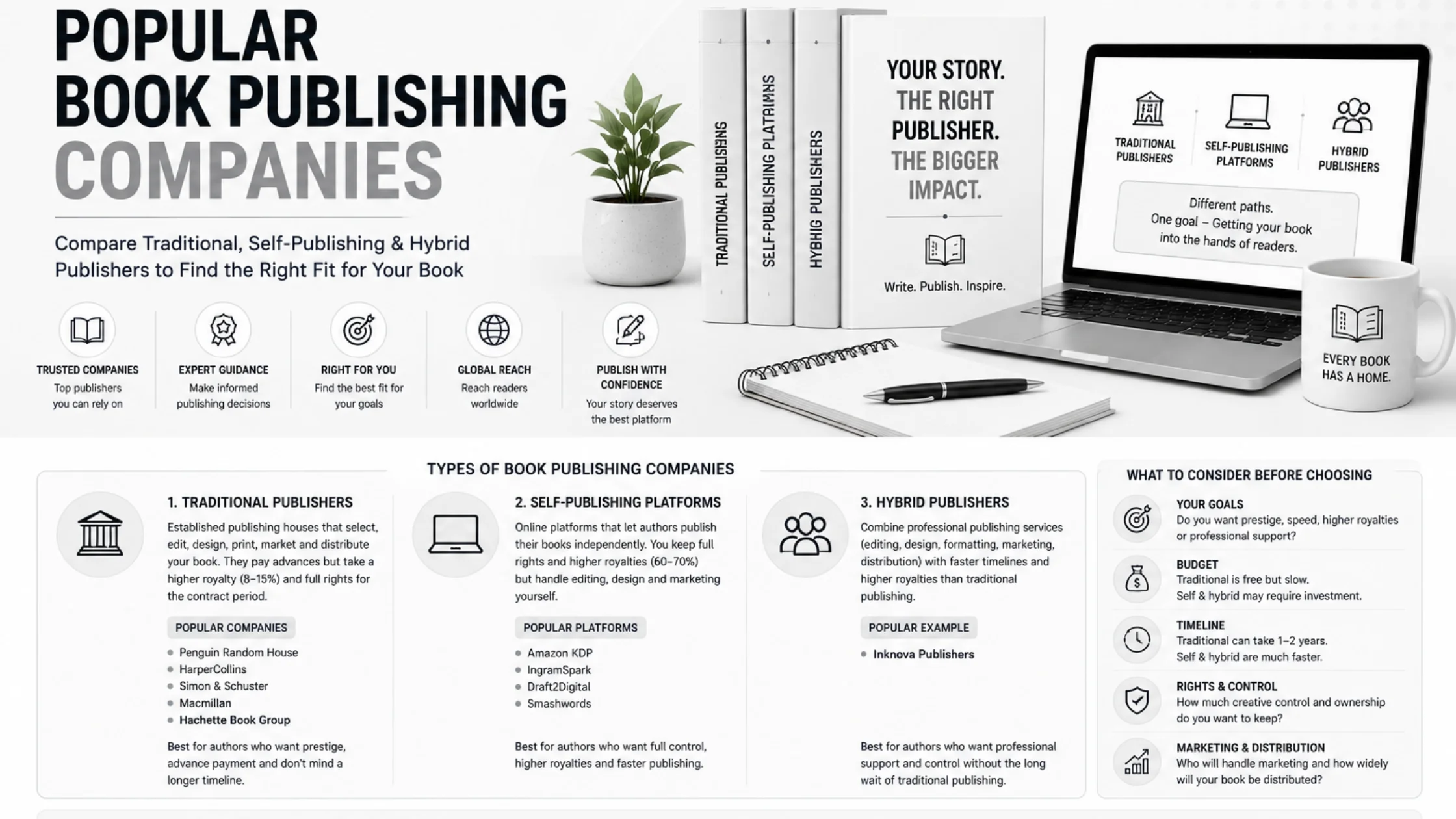
Traditional publishing is what most people picture when they hear the word “publisher.” A house acquires your manuscript, pays you an advance, and handles editing, design, printing, distribution, and marketing. In exchange, they own the rights to publish (and often control) your book for the life of the contract, and you earn royalties typically 8–15% of the cover price.
The Big Five Penguin Random House, HarperCollins, Simon & Schuster, Macmillan, and Hachette still dominate this space. Beneath them sit dozens of respected mid-size and independent presses covering everything from literary fiction to niche nonfiction.
The upside is obvious: no upfront cost to you, an established distribution network, and the credibility that comes with a recognizable imprint on the spine. The downside is just as real. Landing a traditional deal almost always requires a literary agent, submission timelines are measured in months (sometimes years), and rejection rates are steep well over 95% of submissions never make it past the query stage. You also give up a meaningful amount of creative control, from your title to your cover to your release date.
Traditional publishing makes the most sense for authors who have the patience for a long timeline, a manuscript that fits neatly into a marketable category, and no urgency to see the book in print by a specific date.
Self-Publishing Platforms
On the opposite end sits self-publishing and no platform shaped this space more than Amazon Kindle Direct Publishing (KDP). It’s free, it’s fast, and it puts your book on the largest bookstore in the world within 72 hours of hitting “publish.” IngramSpark does something similar but with wider distribution into physical bookstores and libraries, at the cost of a small setup fee and a steeper learning curve. Draft2Digital and Smashwords focus on getting ebooks into retailers beyond Amazon Apple Books, Kobo, Barnes & Noble, and library systems.
These platforms are popular because they remove every gatekeeper. Nobody has to say yes to your book but you. You keep 100% creative control and, depending on the platform, 60–70% of royalties instead of the 8–15% a traditional deal offers.
The catch is that “self-publishing platform” only handles the distribution half of the job. KDP doesn’t edit your manuscript. It doesn’t design your cover. It doesn’t format your interior or write your back-cover copy. Every one of those steps the ones that separate a book that looks professional from one that looks unmistakably amateur is on you to source, hire, and manage separately. For a first-time author juggling an editor, a cover designer, a formatter, and a marketing plan on their own, this can turn into a part-time job nobody signed up for.
Hybrid Publishing Companies
This is where the middle ground lives, and it’s the fastest-growing segment of the industry for a reason. Hybrid publishers combine professional-grade editing, design, formatting, and distribution the parts self-publishing leaves you to figure out alone with the speed and creative control that traditional publishing doesn’t offer. Authors typically pay for the production and services, but retain their rights and earn a much higher royalty share than a traditional contract would provide.
Companies in this space vary widely in quality, so vetting matters more here than anywhere else in the industry. The good ones operate with the discipline of a real publishing house: dedicated editors, professional cover designers, milestone-based payments instead of one lump sum upfront, and clear, fixed pricing with no surprise invoices halfway through the project. The weaker ones are little more than vanity presses charging premium prices for template covers and a Word-to-PDF conversion.
Inknova Publishers sits in this category, with a specific focus on fiction. Rather than trying to be everything to every genre, Inknova works closely with novelists from first-time authors with a finished draft to writers who need help shaping an idea into a complete manuscript pairing them with editors and ghostwriters who understand story structure, pacing, and voice, not just grammar. The appeal for fiction writers specifically is that the team isn’t split across memoirs, business books, and children’s titles; the entire workflow is built around getting a novel from manuscript to market without losing what made the story worth telling in the first place.
That kind of specialization is worth looking for regardless of which hybrid publisher you consider. A company that publishes everything from cookbooks to poetry to technical manuals is rarely going to bring the same depth to your novel’s pacing and character arcs as one that spends its days exclusively inside fiction.
What to Actually Check Before Signing With Any Publisher
Whether you’re eyeing a traditional house, a hybrid publisher, or trying to piece together a self-publishing team, a handful of questions will tell you almost everything you need to know:
Who owns the rights? Traditional deals typically require you to sign over publishing rights for a set term. Hybrid and self-publishing arrangements should let you retain full ownership read the contract to be sure.
What’s the payment structure? Any hybrid or ghostwriting company asking for 100% payment upfront is a red flag. Milestone-based payments a portion at signing, a portion at manuscript delivery, a final portion at publication protect you if something goes wrong halfway through.
Is pricing transparent? You should know the total cost before you sign anything, not discover “editing” and “formatting” as separate add-on invoices three weeks in.
Who actually does the work? Ask directly whether your editor or ghostwriter has relevant genre experience. A memoir editor and a fantasy novel editor are not interchangeable.
What does distribution actually include? “We publish your book” can mean anything from a single Amazon listing to full distribution across Amazon, IngramSpark, Apple Books, and physical bookstore ordering systems. Get specifics.
Is there a guarantee? A company confident in its own editing shouldn’t hesitate to offer some form of money-back guarantee on the early stages of the work, before you’re financially locked into the full project.
Matching the Publisher to the Book
There’s no universally “best” publishing company only the best one for a specific book, at a specific moment, with a specific set of goals.
If you’re chasing a six-figure advance and don’t mind a two-year runway, traditional publishing through an agent is still the only real path. If you’re comfortable managing your own editor, designer, and marketing plan and want maximum control and royalties, a self-publishing platform gives you the tools without the gatekeeping. And if you want the professional finish of a traditional house real editing, real design, real distribution without the wait or the rejection letters, a hybrid publisher is built for exactly that gap.
For novelists specifically, that last option is worth extra consideration. Fiction lives or dies on craft pacing, voice, character, tension in a way that’s harder to fix after the fact than a typo or a formatting error. Working with a hybrid publisher that specializes in fiction, like Inknova Publishers, means the people editing your book are the same people who read fiction for a living, not generalists rotating between a cookbook and a corporate memoir in the same week.
Final Thoughts
The number of ways to publish a book today is genuinely a good thing it just means the responsibility of choosing well has shifted onto the author. Popularity is a starting point for research, not a substitute for it. Read the contract. Ask who’s actually doing the editing. Find out what happens if you’re not happy with the first draft. And pick the path that matches not just your book, but how much control, speed, and support you actually want along the way.
Whichever direction you choose, a finished, well-edited manuscript is still the thing no publisher traditional, hybrid, or self can substitute for. Get that right first, and every option after it gets easier.
