Quick answer: A vanity publisher makes its money from the author’s fees, not from selling the author’s books. A real publishing partner, whether traditional, hybrid, or a service-based company, is clear about costs, lets you keep your rights, and is honest about results. For most first-time authors, the best route is the one that matches their goal, budget, and time. The average cost to publish a book ranges from a few hundred dollars for DIY to several thousand for professional editing, design, and ghostwriting. To make $100,000 from book sales, an author typically needs to sell tens of thousands of copies, depending on royalty rate and price.
If you are a first-time author, you have probably searched questions like these:
- What are some vanity publishers to avoid?
- Who is the best publisher for first-time authors?
- What is the average cost to publish a book?
- How many books do I need to sell to make $100,000?
This guide answers all four, in plain language, without hype. At the end, you will know how to spot a bad deal, what to budget, and how to choose a publishing path you will not regret.

Part 1: What Are Vanity Publishers, and How Do You Avoid Them?
What Is a Vanity Publisher?
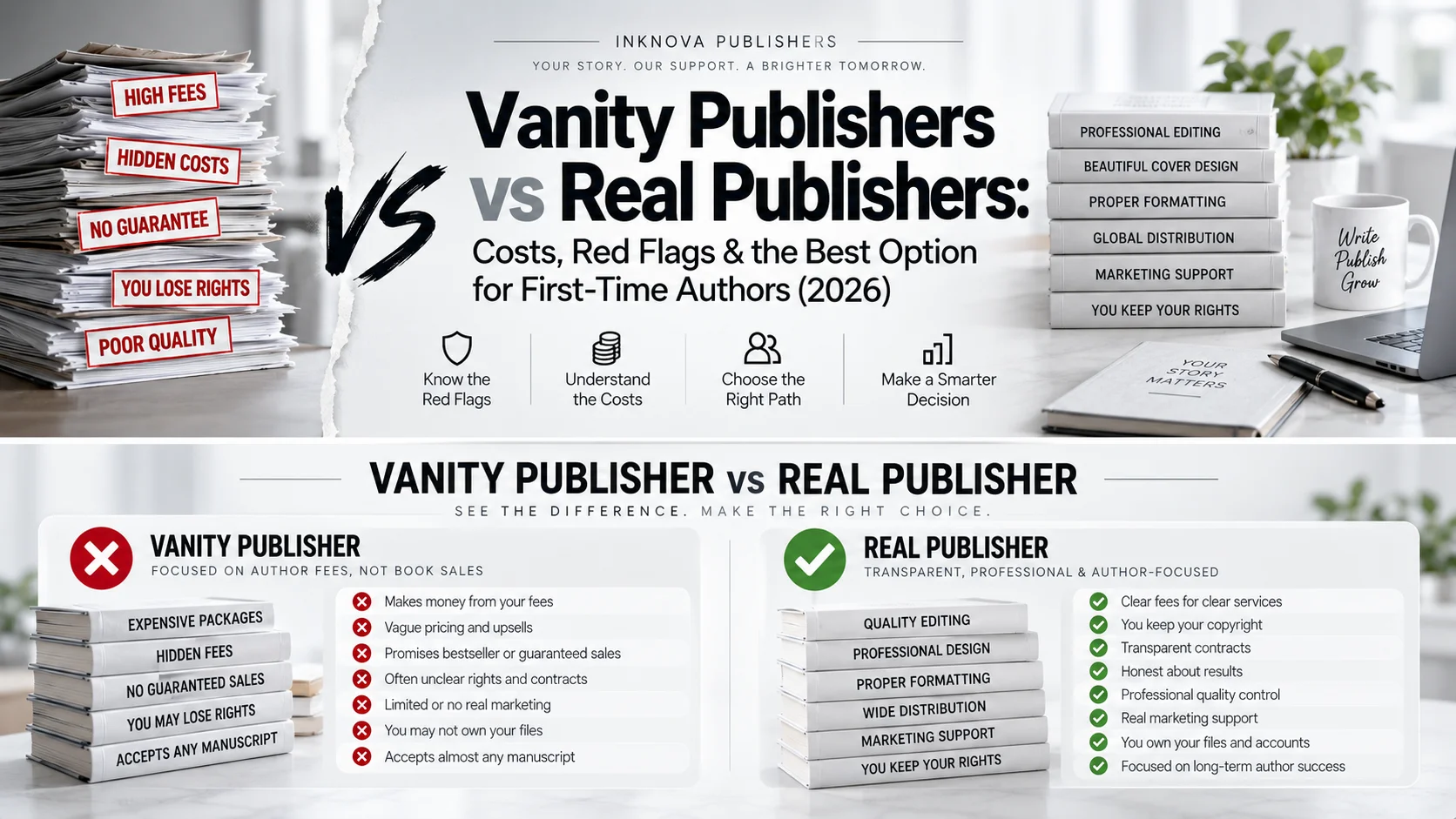
A vanity publisher is a company that charges authors to publish a book but earns most of its income from those author fees, not from real book sales to readers. The focus is on selling you a package, not on selling your book.
Vanity publishing is not always illegal, and not every paid publishing service is “vanity.” Plenty of honest companies offer paid editing, design, and publishing help. The difference is in how they behave: transparency, rights, quality, and honesty about results.
Vanity Publisher vs Legitimate Paid Publishing Services

Red Flags: How to Spot a Vanity Publisher
Instead of relying on a list of company names, which changes constantly, learn to recognize the pattern. Watch for these warning signs.
- They accept every manuscript. A company that never says “this needs work” is selling a service, not protecting quality.
- Guaranteed sales, reviews, or bestseller status. No honest company can promise this.
- Pressure tactics. “This price expires today” is a sales tactic, not a publishing practice.
- Unclear copyright or rights language. If the contract is vague about who owns what, walk away.
- They control your files and accounts. You should be able to access your book files, cover files, and retailer dashboards.
- Hidden or recurring fees. Surprise charges for ISBN, proofreading, file changes, or “distribution” are a bad sign.
- Very high marketing package prices with vague deliverables. “Premium marketing” with no list of exactly what is included.
- No portfolio, or fake-looking reviews. Real publishers show real books, real authors, and consistent online profiles.
- Long lock-in contracts. Multi-year terms with no clear exit.
- Cold calls or emails flattering your manuscript. Be careful if someone you never contacted praises your work and quickly pushes a paid package.
A Quick Vanity-Publisher Checklist
Before you pay anyone, ask:
- Do I keep 100% of my copyright?
- Do I own the final cover and interior files?
- Will the book be listed under my own account, or the company’s?
- What exactly is included in the price, in writing?
- What is not included?
- Can I leave the contract, and what happens to my files?
- Can I see recent books they have produced?
- Do they have a real, verifiable business address and consistent online presence?
If you cannot get clear, written answers, that is your answer.
How to Check a Company Before You Sign
- Search the company name along with words like “reviews” and “complaints.”
- Check that the website, Google Business Profile, and social pages show the same information.
- Look at their published books on major retailers. Do the covers and interiors look professional?
- Ask for a written scope of work and read the contract slowly.
- Talk to at least two or three companies and compare.
For a local example of how to compare options, see our guide on publishing companies in Dallas, Texas.
Part 2: Who Is the Best Publisher for First-Time Authors?
There is no single “best publisher” for everyone. The best option depends on what you want from the book. Here are the four main routes and who each suits.
1. Traditional Publishing
How it works: A publishing house accepts your book, pays for production, and distributes it. Most large publishers require a literary agent.
Best for: Authors with a strong platform, a polished manuscript, and patience.
Trade-offs: Hard to get accepted, slow timelines (often a year or more), less creative control, and a smaller royalty per copy.
2. Hybrid Publishing
How it works: The author pays a fee and the publisher provides professional production. The author usually earns a higher royalty share.
Best for: Authors who want professional support and are willing to invest.
Trade-offs: Quality varies a lot. Some companies use the “hybrid” label but act like vanity presses, so check the signs above.
3. Self-Publishing With Service Providers
How it works: You stay the publisher and hire editors, designers, and formatters as needed, or use one company that bundles the services.
Best for: Authors who want control, speed, and ownership of their rights.
Trade-offs: You make the decisions, so you need to vet vendors carefully. Marketing is largely on you.
4. Ghostwriting-Led Publishing
How it works: A professional writer drafts your book from your ideas, outline, and voice. The book is published under your name, and you own the rights. The same team can then edit, design, and publish it.
Best for: Authors with a strong story or message but not enough time or writing experience, especially for fiction, memoir, business books, and children’s books.
Trade-offs: It costs more than writing it yourself, and it requires clear communication so the final book sounds like you.
Inknova Publishers works in this space, with a focus on fiction ghostwriting and end-to-end publishing, from concept to a finished, release-ready book.
Which Route Should You Choose?

What a Good Publisher Should Offer a First-Time Author
- Honest feedback on the manuscript, even if it is not what you hoped to hear
- A clear, written scope and timeline
- Editing at the right level for your book
- A genre-appropriate cover and a clean interior
- Distribution to major online retailers, with your name on your own accounts
- Realistic marketing guidance, with no guaranteed-sales claims
- A single point of contact and regular updates
Part 3: What Is the Average Cost to Publish a Book?
Publishing costs vary widely, and anyone who quotes a single number without knowing your book is guessing. Instead of one number, here is how costs break down.
Main Cost Factors
- Word count. Longer books need more editing and formatting.
- Type of editing. Developmental editing (story and structure) costs more than copyediting or proofreading.
- Ghostwriting. Writing a full manuscript is a major service and is priced by length and complexity.
- Cover design. Custom designs and illustrated covers cost more than simple ones.
- Interior formatting. Print and ebook layouts, plus any images or special formatting.
- Illustrations. Children’s books and illustrated books need interior art.
- ISBN and registration. A small cost, but it should be clearly listed.
- Marketing. Launch campaigns, ads, and PR are usually separate from production.
Typical Cost Ranges
Use your own real pricing here. Do not publish numbers you do not actually charge.

Budget Levels at a Glance
- DIY on a tight budget: You do most of the work yourself and pay only for essentials like a cover and basic editing. Lowest cost, highest risk of quality problems.
- Mid-range professional: Professional editing, cover, and formatting, with you handling most marketing.
- Full-service: Ghostwriting or heavy editing, custom design, publishing, and launch support. Highest cost, lowest workload for you.
Ways to Avoid Overpaying
- Get at least three written quotes and compare what is included, not just the total.
- Pay for the services your book needs. Not every book needs every package.
- Never skip editing. It is the most common place where cheap choices backfire.
- Ask about extra charges. Revisions, file changes, and ISBN should be clearly stated.
- Do not pay for guaranteed results. Nobody can guarantee sales.
How Do Authors Earn Money From a Book?
Authors earn through royalties, which are a percentage of each sale. Rates vary by format and platform. For example, Amazon KDP offers different royalty options for ebooks depending on price and eligibility, and print books earn a royalty after printing costs. Terms change, so always check the retailer’s current rates before planning your income.
Part 4: How Many Books Do You Need to Sell to Make $100,000?
The answer depends on how much you earn per copy. The formula is simple:
Copies needed = Target income ÷ Earnings per copy
Here are illustrative examples. These are simplified and use rounded numbers, so treat them as estimates, not promises.

What This Means for You
- The numbers are big. Most books never sell tens of thousands of copies, and that is true for traditional and self-published books alike.
- Higher royalty means fewer sales needed. This is one reason many authors choose self-publishing or hybrid routes.
- Books can earn in other ways. Many authors make more from what the book leads to: speaking, consulting, courses, client work, or a series of books.
- Series help. Readers who like one book often buy the next, so a series can multiply earnings.
- Advances are different. In traditional publishing, an advance is paid against future royalties, so you may not earn more until the advance is earned out.
A healthy mindset is to treat your first book as a strong foundation, for your credibility, your audience, and your future books, instead of expecting it to replace your income right away.
How to Decide: A Simple Step-by-Step Plan
- Define your goal. Income, credibility, legacy, or a creative project?
- Set a realistic budget. Include editing, cover, formatting, and some marketing.
- Pick your route. Traditional, hybrid, self-publishing services, or ghostwriting-led.
- Shortlist three companies. Check their websites, profiles, reviews, and portfolios.
- Request written proposals. Compare scope, timeline, revisions, and total cost.
- Read the contract carefully. Rights, files, exit terms.
- Ask your questions. A good company answers clearly and patiently.
- Start with a clear plan. Agree on milestones before the first payment.
Why First-Time Authors Work With Inknova Publishers
Inknova Publishers helps authors turn ideas and manuscripts into finished, published books. [Add one line about founding year or team if true.]
- End-to-end support. Planning, ghostwriting, editing, cover design, formatting, publishing, and launch support from one team.
- Fiction focus. Fiction ghostwriting is a core service, not an afterthought.
- Clear scope and communication. Defined deliverables and a clear point of contact.
- Author ownership. [Confirm this matches your actual policy: you keep your rights and your accounts.]
- A real business presence. Based in Dallas, Texas, with contact details you can verify.
You can learn more at inknovapublishers.com, or email info@inknovapublishers.com, or call +1 (214) 935-5369.
Frequently Asked Questions
What is a vanity publisher?
A vanity publisher is a company that earns most of its income from author fees rather than from selling books to readers. Typical signs include accepting every manuscript, unclear rights, hidden fees, and guaranteed-sales promises.
Are all paid publishers vanity publishers?
No. Many legitimate companies charge for editing, design, and publishing services. The difference is transparency: clear pricing, honest claims, author ownership of rights, and real quality control.
How can I tell if a publisher is legitimate?
Check for a real business address, consistent online profiles, a portfolio of finished books, clear written pricing, and transparent contracts. Be cautious of guaranteed sales and pressure to sign quickly.
Who is the best publisher for first-time authors?
It depends on your goal. Traditional publishing suits authors with a strong platform and patience. Hybrid and service-based companies suit authors who want professional quality and more control. Ghostwriting-led publishers suit authors who have an idea but not the time to write.
What is the average cost to publish a book?
Costs vary by word count, editing level, design, illustrations, ghostwriting, and marketing. DIY routes cost the least, while full-service ghostwriting and publishing cost the most. Always compare written quotes from several companies.
How much does it cost to self-publish a book?
Self-publishing can cost a few hundred dollars if you do most of the work yourself, and more if you hire professional editing, design, and formatting. The key is not to skip editing and cover design.
How many books do I need to sell to make $100,000?
It depends on your earnings per copy. As a rough example, at about $3.50 per ebook sale, you would need around 28,500 copies. At about $1.70 per traditional paperback sale, you would need closer to 59,000 copies.
Do I keep my rights if I use a publishing company?
With most self-publishing and ghostwriting-led services, yes. With traditional publishing, rights are often licensed or transferred. Always confirm this in your contract before signing.
Can a publisher write my book for me?
Yes. A ghostwriting service pairs you with a professional writer who drafts the book from your ideas and outline. The book is published under your name.
Do I need a literary agent?
For most large traditional publishers, usually yes. For self-publishing and many hybrid or service-based routes, no.
Is hybrid publishing worth it?
It can be, if the company is transparent, the quality is high, and you keep your rights. Check the red flags above, and ask exactly what the fee covers.
How long does it take to publish a book?
Self-publishing and hybrid routes often take a few months from final manuscript to release. Ghostwritten books take longer because the manuscript is written first. Traditional publishing often takes a year or more.
Final Thoughts
Choosing how to publish your first book is a big decision, but it does not have to be confusing. Learn the signs of a vanity publisher, decide which route fits your goal, set a realistic budget, and be honest with yourself about what a first book can earn. Compare at least three companies, read every contract, and never pay for promises you cannot verify.
If you have a story, a manuscript, or just an idea, Inknova Publishers can help you plan your next step. Reach out for a free consultation at inknovapublishers.com.
